

Introducing the ELM Code repository
The Qualifications Courses and Credentials GitLab on code.europa.eu offers a rich collection of open-source resources, documentation, and tools designed to support the implementation of the European Learning Model (ELM). It brings together three key projects:
European Digital Credentials for Learning (EDC)
ELM Support
Qualification Dataset Register (QDR)
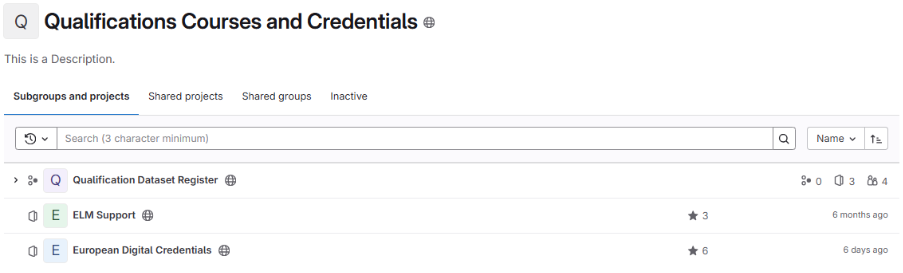
Each project contains useful README files, and structured documentation on how to customise and deploy your own version of
an infrastructure that allows the issuance, storage, verification and viewing of digital, tamper-evident learning credentials, and
a backend service designed to support the storage, indexing and retrieval of structured data on qualifications, learning opportunities, and accreditation.
European Digital Credentials (EDC)
The European Digital Credentials (EDC) open-source code has already been available for several years. This repository offers informative wiki pages explaining how to customise an EDC look and feel, based on a simple basic HTML code, and how to incorporate advanced Thymeleaf references and wildcards to display a wider range of credential properties on a credential’s summary image.
If you are new to issuing EDCs, it is this code.europa.eu repository where you can download the NexU software, which is a remote signature tool allowing the EDC Issuer to access your electronic seal for the sealing process. Please observe the disclaimer on this topic and note that the Commission is investigating alternative solutions to NexU software and will provide an update on this topic in the future.
ELM Support
This project hosts an evolving collection of useful resources. These include unsigned JSON and signed JSON-LD files demonstrating the structure and content of frequently used credential types, such as micro-credentials, certificates of event participation, transcripts of record, degrees and joint degrees.
Through the ELM Support project, we also share step-by-step guidelines of how to build digital micro-credentials in the Online Credential Builder, that are compliant with Annex 1 of the Council Recommendation on a European approach to micro-credentials for lifelong learning and employability. Used together with our training video titled “How to build a Micro-credential”, EDC implementers can create their own custom micro-credential templates, that include all necessary elements, such as the awarding body template, learning achievement, activity and assessment details, and – if desired – a custom HTML code.
In the ELM mapping tables you can find structured comparisons of ELM class properties to data elements compiling micro-credentials, diploma supplements, and ELMO records. These tables aim to provide structured alignment between familiar existing standards, and support interoperability.
Moreover, visual class diagrams explain how various ELM concepts (such as agents, claims, and specifications) connect and function in the European Learning Model in different application context, e.g. publishing accreditation, qualification or learning opportunity data, and building digital credentials.
Qualification Dataset Register (QDR)
As mentioned in one of our previous articles, the Qualification Dataset Register (QDR) is the second application of the European Learning Model that is being made available as an open-source project on code.europa.eu, joining the European Digital Credentials (EDC) code. By releasing the QDR under an open-source license, the European Commission ensures that public administrations, developers, stakeholders and any other party across Europe can reuse and adapt the dataset structure for national, regional/local or sectoral implementations.
You can find a walkthrough of the open-source repository in the Advanced features of European Digital Credentials for Learning webinar, held on 11 December 2025, starting at 17:25.
Stay updated
Currently, the ELM Support Team is working on highly detailed interoperability pages, that will also be published on code.europa.eu over the coming months, therefore we encourage you to keep an eye on the repository. Please join the ELM peer exchange group on Futurium to be able to receive timely updates on these developments.
Should you have any questions on the code.europa.eu repository, please get in touch with: EMPL-ELM-SUPPORT@ec.europa.eu.
 Facebook
 Twitter
 Linkedin
 Email
Email