

Making qualifications easier to understand: comparing single qualifications on Europass
In a rapidly evolving and increasingly interconnected learning landscape, understanding and comparing qualifications across countries and systems has become essential. Learners, jobseekers, employers and recognition bodies are often faced with the challenge of interpreting diverse qualification systems, levels and learning outcomes. To support more transparent and informed decision-making, Europass has introduced a feature that allows users to compare single qualifications directly on the platform.
While the tool for comparison of national qualifications frameworks (NQFs) supports understanding of how qualification levels relate across countries and to the EQF, this new feature for comparing single qualifications goes a step further by focusing on the concrete content and key characteristics of specific qualifications that are part of NQFs.
Accessing this new feature is simple and intuitive. Users can follow these steps to compare individual qualifications:
Go to the Europass course and qualifications search page
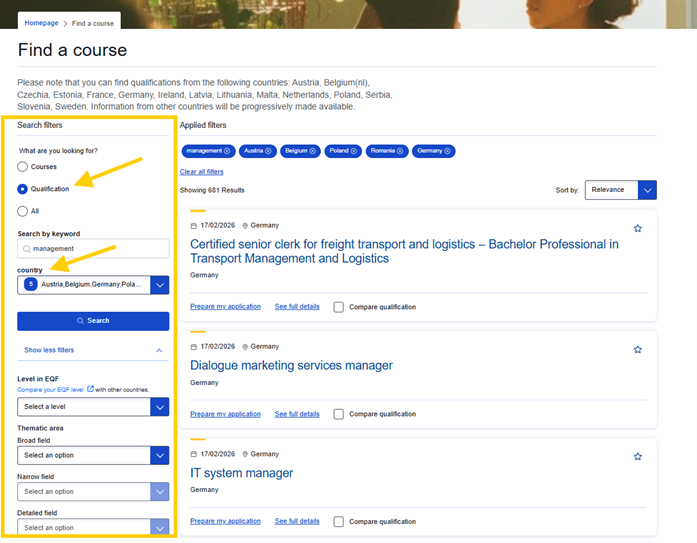
Use the filters on the left-hand side to refine the search by selecting “Qualifications”, choosing countries of interest, and/or entering keywords
Browse the results and identify relevant qualifications
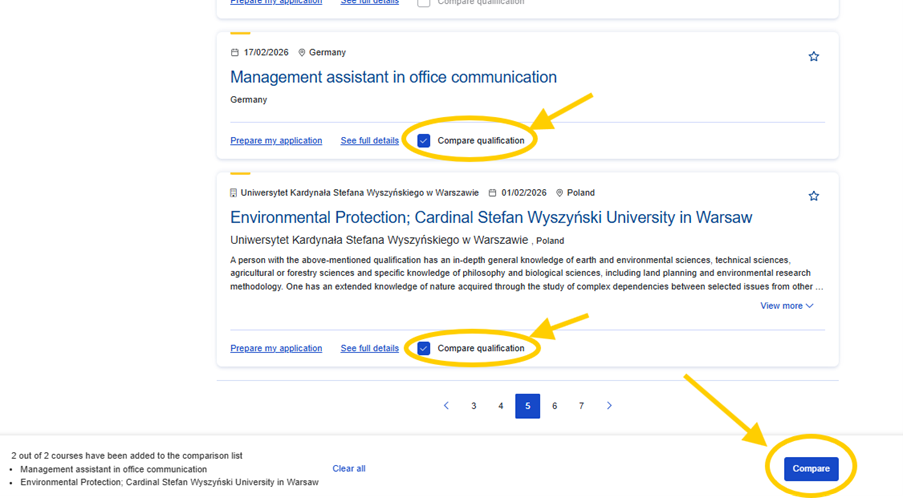
Select two qualifications by ticking the “Compare qualification” checkbox displayed on each result
Review the selection and click the “Compare” button
Once selected, users are taken to a dedicated comparison page, where the chosen qualifications are displayed side by side in a structured table. This comparison table presents key information in a clear and accessible way, including the qualification title, thematic area, provider, language of provision, EQF and NQF levels, and learning outcomes. By organising this information in a consistent format, even complex elements (such as learning outcomes) are easy to review and understand, allowing users to quickly identify similarities and differences between two qualifications.
This feature brings clear added value to a wide range of stakeholders. For individuals, including learners and jobseekers, it supports more informed choices by making it easier to understand and compare qualifications and identify options that match their goals and aspirations. For employers and recognition bodies, it offers a practical way to assess qualifications from different countries, supporting more transparent and efficient recognition and recruitment processes. It also benefits Member States and data providers by encouraging the provision of high-quality, structured qualification data, improving the overall reliability and usability of information. More broadly, the comparison of individual qualifications contributes to European priorities such as skills transparency and portability, supporting a more integrated learning and labour market across borders.
In this way, the feature supports a clearer understanding of qualifications and helps users navigate learning across countries with greater confidence.
 Facebook
 Twitter
 Linkedin
 Email
Email