

In this section, you can find the details on how to prepare and publish your data on Europass.
When deciding which information to publish, there is one important rule to follow:
Unless you have the responsibility to do so – per your national laws or internal codes of conducts – publish only data which you are the owner of.
You are the ‘owner’ when you define, describe, revoke and manage given data. If you nevertheless publish data that you do not own, it may lead to unnecessary data redundancy. The QDR outlines specific publishing agreement that must be signed before publication.
When publishing to the QDR, your datasets will have to be in ELM format, using either the Learning Opportunities and Qualification (LOQ) application profile or the Accreditation application profile. You can access the schemata documentation here.
- LOQ Application Profile: Providing information about Learning Opportunities and Qualifications. The ELM allows for the record of information in a unified way. Information about learning opportunities and qualifications, including the description of qualification standards, can be used for course catalogues, training announcements and learning opportunity databases, allowing universally comprehensible data to be easily exported and described in the same way across borders.
- Accreditation Application Profile: Publishing information on licensing and accreditation of educational institutions and/or their programmes, as well as issuing accreditation credentials to licenced or accredited organisations.
To learn more about the ELM, please visit the ELM in the QDR page. You can also visit the ELM datamodel browser here.
The first real step towards the publication is to assign an identifier to all the concepts. To do so, you may have the following questions:
An identifier allows to identify in a unique way the concept you publish information about. This is necessary to make sure you can link the information to other information on the web, without having the risk of losing track where the information comes from. On the web, different sources can publish information about the same concept. But how do we know they are talking about the same concepts? By looking at the identifier. If someone else wants to refer to your concept, then they will use the identifier to do so.
Every ‘concept’ needs to get an identifier. A concept is an ‘entity’ you want to publish information about: a learning opportunity, an organisation, a country, an awarding body, …
Some of these concepts will already have an identifier. To know which concepts have an identifier and which do not, you must check the ELM schema. Every “instance” of a class needs an identifier.
A university provides foreign languages courses as Learning Opportunities:
- Icelandic as a second language;
- Dutch for foreigners
These two different learning opportunities will each get a different identifier.
A secondary vocational education institution provides professional courses as learning opportunities:
- professional course of kitchen/pastry technician
- professional course of restaurant/bar technician
These two different learning opportunities will each get a different identifier.
A university awards different qualifications in the engineering department:
- Bachelor of industrial sciences;
- Master of industrial sciences: Chemical engineering;
- Master of industrial sciences: Electronic engineering.
A Vocational Education and Training (VET) provider awards different VET qualifications in the field of ICT:
- Qualification of ICT worker;
- Qualification of ICT service worker;
- Qualification of ICT service desk manager.
In both cases, these three different qualifications will each get a different identifier.
The identifier must be globally unique. This means that there is no other identifier in the world that is the same.
The identifier must be persistent: it should not change when the concept itself changes (for example when it changes location, or when a Learning Opportunity changes its name). Once you assign an identifier, it should always refer to the same concept (whenever, even if the concept does not exist anymore). This is needed because other systems might still use the identifier to refer to the concept.
In the best case, the identifier is dereferenceable: this means that anyone who uses the identifier, can access the concept itself. However, this is not a requirement.
You can design identifiers however you like if they meet the requirements of being unique and persistent.
If your organisation uses a system to assign codes to concepts, such as a national code for each qualification, then you can start from these codes to build identifiers. If you, however, prefer to use the code as an identifier itself, you must foresee that the identifiers are persistent and globally unique.
The best practice is to use URIs (Uniform Resource Identifiers) as identifiers. Uniqueness and persistence are guaranteed by the strategy of URIs. But it is possible to use identifiers other than URIs. In that case, you might have to foresee a way to build in uniqueness and persistence yourself.
Both options are explained with examples below.
An example of a URI structure would be the following:
| http://data.domain.eu/collection/type/key | ||
| domain (required) | Start from a domain name that your organisation owns. | University ABC has its website at http://www.universityABC.nl. They register http://data.universityABC.nl as a domain name for building identifiers. Remark: Adding “data” shows that this is to publish data, not documents. It is not required; however, you might have to register this as a new domain name. |
| collection (recommended) | A collection subdivides the domain into collections of entities | http://data.universityABC.nl/courses |
| type (recommended) | The type defines what kind of entity is described | http://data.universityABC.nl/ courses/learningopportunity or http://data.universityABC.nl/courses/qualifications |
| key (required) | The key makes the entity unique | http://data.universityABC.nl/ courses/learningopportunity/001 or http://data.universityABC.nl/courses/qualifications/Q1234 |
The strategy of URIs implicitly ensures that the URI is unique. Since you are the only owner of the domain, it is up to you to keep the identifiers unique within your domain. It is your responsibility to manage the keys within your domain and keep them unique.
If your organisation already uses a system to assign codes to the concepts you want to identify, you can use these codes as identifiers. In that case, you should foresee a mechanism to make the codes persistent and unique. QDR handles making these identifiers unique by combining them with a namespace that you define during the publication.
Best practice is to use these codes to build URIs. URIs ensure the uniqueness and persistence are guaranteed. See Use URIs as identifiers above.
Learning Opportunities Example: In the national database, learning opportunities get a national ID code when they are officially recognised by the government. Everyone can consult these codes in the register. These codes are unique and persistent because they are managed on a national level. You could use these codes – without modification – as identifiers for the learning opportunity you want to publish information about. During publication in QDR these codes are amended with a namespace which makes them globally unique.
Qualifications Example: In the Netherlands, qualifications get a CROHO code when they are officially recognised by the government. When you study arts & crafts e.g., the qualification you obtain is “Associate Degree Arts & Crafts” with code 80078. Everyone can consult these codes in the online CROHO register. These codes are unique and persistent because they are managed on a national level. You could use these codes – without modification – as identifiers for the qualifications you want to publish information about. During publication in QDR these codes are amended with a namespace (e.g. https://apps.duo.nl/MCROHO), which makes them globally unique.
In cases where you have your own codes, make sure you keep them unique and persistent at all times.
This section provides a model that you can use to model the information that you want to publish.
The ELM is an RDF vocabulary with an RDF ontology and set of application profiles. Additionally, there are XML schemata available to support the encoding of information in XML. The schemata also define controlled vocabularies as fixed value lists for some properties in the schema.
ELM is applicable in many contexts. They can be applied to encode, publish and exchange qualification metadata in many technologies, including:
You can find the schemata documentation here.
Investigate how the metadata schema applies to your data
Look at the classes in the ELM LOQ or Accreditation application profile (depending on the data you are publishing) and compare with the classes of your own information model. Do they correspond to each other? Try to find out how the entities in your model correspond to the classes of the schema.
How are the entities in your own information model related to one another? Look at the properties in the metadata schemata to see if you can use them to express the relationships between the entities.
The ELM consists of classes and properties, divided into three kinds:
- Required data fields: fields that you ''must'' publish in any case;
- Recommended fields: fields that you should publish in case they are available;
- Optional data fields: fields that you can choose to publish, to give more information on the qualification or learning opportunity.
The more recommended and optional data fields used, the richer the data becomes. For Europass users it is relevant to find relevant and up to date information about a qualification
The tables below provides only the required data fields for each type of data (Learning Opportunities, Qualifications and Accreditations) with the information on:
- Label: referring to the property name (first column) ;
- Cardinality: indication of possible occurrences of given element (0.. meaning optional, 1.. compulsory and ..1 meaning maximum 1 value while ..* meaning potentially multiple values);
- Description: contains the definition of the property.
The learning opportunities required and recommended data fields are provided i below. For all the data fields, please refer to the QDR Document Library.
A learning opportunity is any course, education or training available to an individual, taking the form of onsite, online or blended learning, in a formal or non-formal context. The opportunity is provided at a given time usually with the aim to obtain a certain learning award, such as a qualification. A learning opportunity can, but does not necessarily have to, be linked to a qualification.
Example: I attend a two-year VET course which leads to a qualification of dental assistant. In parallel, I attend a five-hour PPT crash course organised by the national employment service, which leads to a certificate of attendance. Both are learning opportunities.

Learning Achievement Specification
A description of a set of knowledge and/or skills used with responsibility and autonomy, which may be acquired. For further information about specifications, please refer to the introduction to the ELM.

The Qualification required and recommended data fields are provided in the table below. The list of the elements for data fields for the electronic publication of information on qualifications with an EQF level is gathered in the Annex VI of the EQF Council Recommendation previously mentioned.
A specification of an assessment and validation process which is obtained when a competent authority determines that an individual has achieved learning outcomes to given standards. A Qualification is a subclass of the Learning Achievement Specification.

Since 2004, learning outcomes as a principle have been systemically promoted in the EU policy agenda for education, training and employment. The 2017 EQF Recommendation defines learning outcomes as ‘…statements of what an individual should know, understand and/or be able to do at the end of a learning process, which are defined in terms of knowledge, skills and responsibility and autonomy.’ This same definition has been integrated within the European Learning Model.
In line with this approach, learning outcomes are a mandatory field when publishing information on qualifications and learning opportunities in accordance with the European Learning Model, helping to bind together the different European tools developed in the last decade.
In June 2024 Cedefop and the European commission published the European guidelines for the development and writing of short, learning-outcomes-based descriptions of qualifications developed in the EQF-Europass project group (from here on the guidelines). The publication offers recommendations on the formal aspects (length, format) and content (scope, complexity, context) of these descriptions. It also includes practical resources, such as lists of action verbs and qualifiers, to help describe clearly the learning outcomes of qualifications.
We invite any entity that is publishing or considering to publish data to the QDR to familiarise themselves with the guidelines to learn to draft and structure learning outcomes that are published via the QDR.
The provision of learning outcomes data is crucial for the quality of data provided, helping to improve the understanding and portability of qualifications. Short, specific learning outcomes can help individuals showcase the value of their qualifications in their job application or requests for recognition.
When publishing to the QDR, the use of either the ‘learning outcome’ and/or the ‘learning outcome summary’ field is mandatory. To publish your learning outcomes in accordance with guidelines, you will need to use both, where:
- The narrative presenting the overall objectives and orientation of the qualification corresponds to the ‘Learning Outcome Summary’ field (elm:learningOutcomeSummary) in ELM.
- Each individual bullet point expressing learning outcomes is referenced using the ‘Learning Outcome’ field (elm:LearningOutcome)
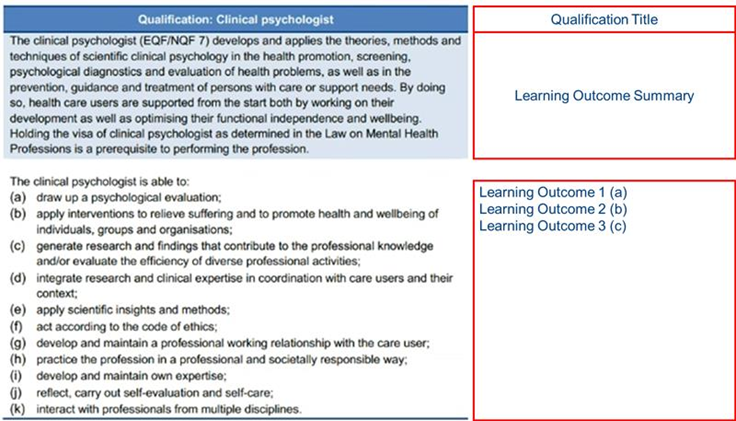
Illustration of the ELM fields corresponding to the short descriptions of Learning Outcomes
By using these fields, the short descriptions of learning outcomes will be correctly visualised in Europass.
Data publishers can also choose to supply additional information for each individual learning outcome (corresponding to the bullet points in the guidelines), as well as related ESCO skills. This allows for the provision of richer data and aid the course and qualification recommender system in Europass.
For further information on how to structure the data, we invite you to refer to the LOQ schemata files available here.
The Accreditation required and recommended data fields are provided in the table below. For all the data fields, please refer to the Schema files published here.

In some cases, you may be able to fit such information into “AdditionalNote”, if this is not possible it is better to omit to publish it. In case you believe the information is important and not represented in the schemata, you can suggest additional data fields for future improvement.
This is not a problem. It is allowed to use only a subset of the classes (and properties) of the LOQ schema. While every class has mandatory properties in the LOQ Application Profile, you do not need to inform all classes in your learning opportunity / qualification data. Every Learning Opportunity must be specified by either a Learning Achievement Specification or a Qualification (that is a special kind of Learning Achievement Specification); if your learning opportunity is not specified by a Qualification, you do not need to supply QF values even though the EQF and NQF levels are mandatory properties of the Qualification class.
The European Commission is aware that additional mandatory fields can restrict countries from publishing and this delays the publication process. However, additional required fields also enrich the data and work as an incentive to gather the data from the data providers at national level.
If the data for a mandatory field is not yet available, the European Commission is open to discuss together with the data-provider the possibilities for a temporary workaround. The goal is to avoid that countries cannot publish because they are unable to provide the mandatory fields data. This should be under the condition that the workaround is temporary, and work will be done to commit to the mandatory fields to best serve the Europass end-users.
The language is apparent in some of the properties of a concept, for example, the title of qualification / learning opportunity or its homepage.
Example 1 (qualifications): In the Netherlands, the official title of a bachelor’s in chemistry is ‘B Chemie’ (CROHO code 34396). In English, the official title is ‘B Chemistry’. But an awarding body can refer to it as ‘Bachelor in de Chemie', which is an alternative Dutch title. This would be modelled as such:

Example 2 (learning opportunities): In the Netherlands, the official title of an opportunity is ‘NL English’. In English, the official title is ‘EN English’. But an awarding body can refer to it as ‘English taught in Dutch’, which can server as alternative English additional note. This would be modelled as such:

Qualifications and learning opportunities may be linked together to strengthen the network of the data and lower redundancy of information. Such links state that a given learning opportunity is specified by a qualification – i.e. the opportunity leads to awarding of given qualification.
In order to establish such a relation using QDR, your organisation should implement the following steps:
- Publish a qualification dataset: The qualification dataset must always be created first – the learning opportunity dataset afterwards refers to the existing qualifications it contains;
- Note the qualification reference: The learning opportunities must refer to the qualification data with their ID and the namespace of the dataset that the qualification is located in;
- Publish the reference XML: The XML should indicate the reference to a qualification in the following way:

- Qual. Dataset. Namespace: Namespace of the dataset where the reference qualification is located
- Qual. ID: ID of the qualification that is being referred to
Example: Example of such a structure would be:
